
Titus Morebu
Author
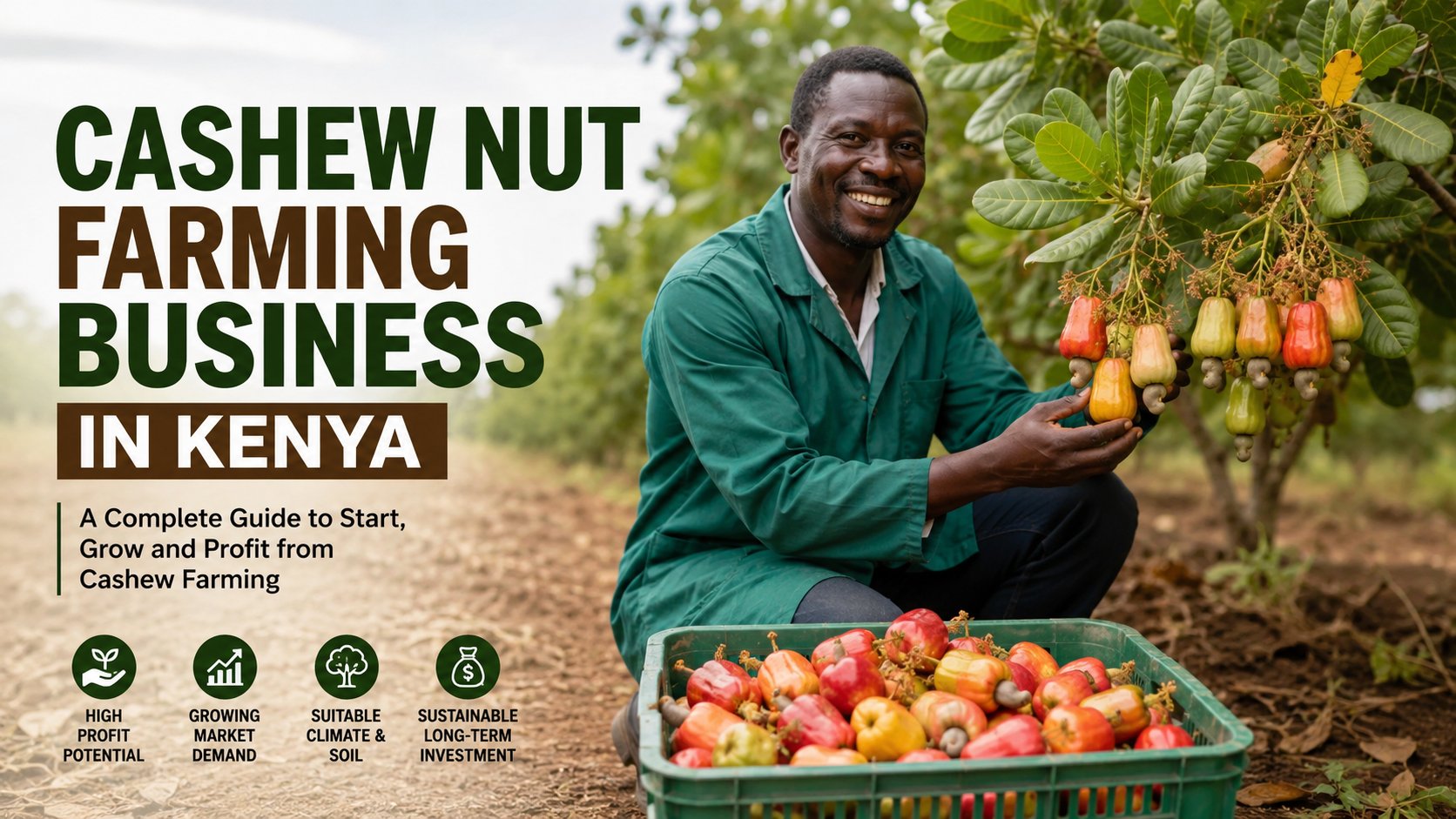
Cashew Nut Farming Business in Kenya: Costs, Profit & Guide
Learn how to start a profitable cashew nut farming business in Kenya, including costs, varieties, planting, yields, pests, harvesting, markets and profits.
🌰 Cashew nut farming is one of the most promising long-term agribusiness opportunities in Kenya, especially for farmers in the Coast region and other warm, low-altitude areas. Demand for cashew nuts remains strong in Kenya and export markets because cashews are consumed as snacks, used in baking, blended into nut butter, processed into dairy alternatives, and sold to food manufacturers. At the same time, Kenya has been working to revive cashew production through improved planting materials, farmer training, and renewed interest in tree crops.
For an investor or farmer thinking beyond seasonal crops, cashew farming offers something valuable: a drought-tolerant perennial crop with multiple income opportunities. You can earn from raw nuts, processed kernels, seedlings, and value-added products. If managed properly, a cashew orchard can remain productive for many years while fitting well into a diversified farm business.
This guide explains how to start a cashew nut farming business in Kenya, where it grows best, the startup costs, how much you can earn, the main production risks, and how to position the venture for profit.
🌍 Why Cashew Nut Farming Is a Serious Business Opportunity in Kenya
Cashew is not just another tree crop. It is a business with several strong fundamentals:
- It suits dry and warm areas. Cashew trees are more tolerant to dry conditions than many annual crops, making them attractive in areas with unreliable rainfall.
- There is room for production growth. Kenya’s cashew industry has long underperformed compared with its potential, which means good farmers can benefit as the sector modernizes.
- It has multiple market channels. You can sell raw nuts to traders, processors, wholesalers, retailers, or directly to consumers after value addition.
- It is a long-term asset. Once the orchard is established, the trees can produce for many years with proper care.
- It fits climate-smart farming. Cashew can be part of a resilient farm system in coastal and semi-arid zones.
Kenya’s cashew revival has been supported by improved varieties and seedling distribution efforts. Newer varieties and better orchard management can significantly improve yields compared with the old neglected trees that dominate many farms today.
📍 Best Areas for Cashew Nut Farming in Kenya
Cashew performs best in hot, frost-free, low-altitude areas. In Kenya, the traditional cashew belt is the Coast region, but some other warm areas also have potential depending on altitude, rainfall pattern, and soils.
Top counties and zones to consider
- Kilifi – one of the best-known cashew-growing counties and a major reference point for commercial production.
- Kwale – suitable climate and a strong history of tree crops.
- Lamu – warm coastal conditions favor cashew establishment.
- Tana River – suitable in the right locations, especially where soils drain well.
- Taita Taveta – selected areas may support cashew, though suitability varies by microclimate and altitude.
- Some parts of Makueni, Embu, Meru, Tharaka Nithi and Busia – only after confirming local suitability with agricultural officers or research stations.
Ideal growing conditions
- Altitude: generally low-altitude areas are preferred. Cashew performs best closer to sea level and in warm tropical zones.
- Temperature: warm conditions are ideal. Cashew thrives in hot environments and does not tolerate frost.
- Rainfall: moderate rainfall is enough, provided the site has a clear dry period and good drainage.
- Soils: well-drained sandy loam or light loamy soils are ideal. Waterlogging is a major problem for cashew.
- Soil pH: slightly acidic to near neutral soils are generally suitable.
Before planting on a commercial scale, it is wise to confirm local suitability through your county agriculture office, a KALRO station, or a reputable nursery that understands cashew production in your area.
🌱 Cashew Varieties in Kenya: Why Planting Material Matters
The biggest mistake many farmers make is planting poor-quality or unknown seedlings. Cashew is a long-term crop, so your returns depend heavily on the genetics you establish in the orchard. Kenya has been promoting improved cashew planting materials to address the low productivity of old trees.
What to look for when buying seedlings
- Buy grafted or improved seedlings where available. These are generally preferred over random seed-propagated trees because they can offer better uniformity and earlier, stronger production.
- Source from a trusted nursery. Ask where the mother material came from and whether the nursery works with recognized agricultural institutions or county programs.
- Inspect seedling health. The seedlings should be vigorous, disease-free, and not root-bound.
- Ask about yield potential and adaptation. A good nursery should explain how the variety performs in your region.
Recent public updates in Kenya have highlighted the rollout of improved cashew varieties and seedlings aimed at boosting production, especially in coastal counties. This is a strong sign that commercial farmers should avoid the old “plant anything and hope” approach.
🧮 Is Cashew Nut Farming Profitable in Kenya?
Yes—cashew farming can be profitable in Kenya, but it is not a quick-cash crop. It is best treated as a medium- to long-term agribusiness. Profitability depends on:
- the quality of seedlings you plant,
- the acreage under production,
- how well you manage weeds, pruning, nutrition, and pests,
- whether you sell raw nuts or do value addition,
- the age of the orchard, and
- your market access.
A poorly managed orchard of old trees can be disappointing. A well-planned orchard with improved seedlings, clean field management, and strong market connections can become a valuable long-term income stream.
💰 Cashew Nut Farming Business Model Options
There is more than one way to make money from cashew. A smart entrepreneur looks beyond selling raw nuts only.
1) Selling raw cashew nuts
This is the simplest entry model. You grow, harvest, dry, and sell raw nuts to traders, processors, or aggregators. It requires the least processing equipment but usually offers the lowest margin per kilogram.
2) Selling processed kernels
Instead of selling raw nuts, you can process and sell edible cashew kernels. This can fetch far higher prices than raw nuts, but it requires proper shelling, drying, grading, packaging, food safety discipline, and careful handling because cashew shells contain irritating compounds.
3) Selling branded retail packs
You can roast, salt, flavor, and package cashews for supermarkets, gift shops, hotels, e-commerce stores, and direct online customers. This is where branding and margin can improve significantly if you build a trusted consumer product.
4) Raising and selling seedlings
Where demand for orchard establishment is rising, a nursery business can complement a cashew farm. Farmers who learn propagation and nursery management can sell quality seedlings to other growers.
5) Mixed orchard plus intercropping system
Because cashew takes time to reach full production, some farmers use the early years to intercrop with short-term crops where agronomically appropriate. This can improve land use efficiency and generate cash flow while the orchard matures.
🪴 How to Start a Cashew Nut Farming Business in Kenya
Step 1: Choose the right land
Do not begin with seedling purchase. Begin with site selection. A beautiful orchard on unsuitable land will frustrate you for years. Check:
- whether the area is warm enough for cashew,
- whether drainage is good,
- whether the land is accessible for harvesting and transport,
- whether you can secure water for seedling establishment if rains fail, and
- whether theft risk and animal damage can be controlled.
Step 2: Test the business model before planting
Decide whether your goal is:
- selling raw nuts,
- building a processing and packaging brand,
- supplying processors at scale, or
- combining farming with nursery sales.
Your model affects how many trees you plant, what post-harvest facilities you need, how much capital you require, and what licenses or food handling systems you may eventually need.
Step 3: Prepare land properly
Clear bushes, remove stumps, and plan the orchard layout before the rains start. Mark planting spots early. Cashew trees need room because mature canopies spread widely. Good layout improves movement, spraying, pruning, and harvesting.
Step 4: Buy quality seedlings
Do not cut corners here. One bad seedling decision can affect your orchard for decades. Ask about the seedling source, age, and recommended planting conditions.
Step 5: Plant at the right time
Plant at the onset of reliable rains. This gives seedlings the best chance to establish without excessive watering costs. In drier areas, planting too late into a short rainy season can lead to high mortality.
Step 6: Mulch, weed and protect the young orchard
The establishment phase determines future performance. Young cashew trees must not struggle with weeds, moisture stress, or livestock damage. Mulching helps conserve moisture, suppress weeds, and improve soil health.
Step 7: Build market relationships early
Do not wait until harvest to start looking for buyers. Start talking to traders, processors, nut brands, wholesalers, and county agriculture officers early. Understanding the market ahead of time helps you decide whether to focus on raw nuts, kernels, or value-added retail packs.
📏 Spacing and Orchard Layout
Cashew trees need generous spacing because they develop broad canopies. In many orchards, spacing of about 10 metres by 10 metres is used as a practical reference for full-sized trees, though local advice may vary depending on variety and production system.
At this spacing, you can estimate roughly 40 trees per acre. Some farmers may use different arrangements depending on land shape, topography, and whether they intend to intercrop in the early years.
Why spacing matters
- It reduces competition for light, water, and nutrients.
- It allows proper airflow, which can reduce disease pressure.
- It makes harvesting easier.
- It leaves room for machinery, spraying, and pruning.
🕳️ Planting Holes and Planting Procedure
Prepare holes before the rains so the soil is ready when planting begins. A common approach is to dig generous holes and mix topsoil with well-decomposed manure before planting. Avoid using fresh manure directly in planting holes because it can damage young roots.
Basic planting tips
- Use healthy, well-hardened seedlings.
- Plant at the same depth the seedling was in the nursery container.
- Firm the soil gently around the root ball.
- Water immediately after planting if moisture is insufficient.
- Stake the seedling if the site is windy.
- Mulch around the plant, but do not pile mulch against the stem.
🌿 Fertilizer, Manure and Soil Nutrition
Cashew trees are hardy, but that does not mean they should be neglected nutritionally. Good orchard nutrition supports vegetative growth, flowering, fruit set, and tree health.
Practical nutrition approach
- Start with organic matter. Well-decomposed manure or compost improves soil structure and moisture retention.
- Use soil testing where possible. A soil test is the best way to know whether you need phosphorus, potassium, lime, or other amendments.
- Feed young trees for establishment. Young trees need support to build a healthy canopy and root system.
- Maintain mulch around the tree basin. Mulch helps conserve moisture and contributes organic matter over time.
If you are establishing a commercial orchard, involve an agronomist or local extension officer in developing a feeding schedule suited to your soil and rainfall pattern rather than copying a generic fertilizer program blindly.
✂️ Pruning and Orchard Management
Pruning is often ignored in tree crops, yet it can make a major difference in orchard productivity and ease of management. Cashew trees should be shaped early and maintained so that the canopy remains healthy and manageable.
Why prune cashew trees?
- To remove dead, diseased, or damaged branches.
- To improve light penetration into the canopy.
- To encourage a strong framework in young trees.
- To reduce overcrowding and improve airflow.
- To make harvesting easier.
Good orchard management also includes weed control, mulching, scouting for pests and diseases, replacing dead seedlings early, and keeping records of tree performance and inputs.
🐛 Common Pests and Diseases in Cashew Farming
Cashew is hardy, but it is not pest-proof. Farmers should monitor the orchard regularly rather than waiting until damage becomes severe.
Possible pest and disease challenges
- Insect pests that attack flowers, shoots, leaves, or developing nuts.
- Fungal diseases that affect leaves, flowers, or young fruits, especially where orchard hygiene is poor or humidity is high.
- Stem and branch damage caused by physical injury or secondary infections.
- Rodent or animal damage in some locations, especially in young orchards.
How to reduce losses
- Buy clean seedlings from reputable nurseries.
- Maintain proper spacing and prune where necessary.
- Keep the orchard clean and reduce weed pressure.
- Inspect trees frequently during flowering and fruiting periods.
- Seek guidance from local agricultural officers on approved crop protection products and safe application.
Always follow current Kenyan pesticide regulations and label instructions. Product choices, rates, and approvals can change, so farmers should rely on updated guidance rather than old spray routines.
⏳ How Long Do Cashew Trees Take to Mature?
Cashew is not a one-season crop. You should enter the business with a long-term mindset.
- Seedling establishment phase: the first year is mainly about survival, root development, and canopy establishment.
- Early bearing phase: improved trees may begin giving some production earlier than unimproved seedling trees, but yields are still modest at first.
- Commercial production phase: meaningful production improves as the orchard matures and management stabilizes.
The exact timeline depends on the variety, seedling quality, management, rainfall, and site conditions. If you are planting cashew, budget for a waiting period before the orchard becomes a major income source.
🧺 Harvesting Cashew Nuts in Kenya
Harvesting is not just about picking nuts. It is a quality-control stage that affects your sale price and storage losses.
Good harvesting practices
- Collect mature fallen produce promptly to reduce spoilage and losses.
- Separate the nut carefully from the cashew apple where appropriate.
- Dry the nuts properly before storage.
- Do not mix wet nuts with dry nuts in storage.
- Use clean bags and a dry storage area.
Cashew nuts should be dried adequately before storage to minimize mould risk and quality deterioration. Poor post-harvest handling can wipe out the benefit of a good harvest.
🏪 Cashew Nut Markets in Kenya
One of the strengths of the cashew business is that there are multiple routes to market. The best choice depends on your scale, location, and whether you are doing value addition.
Main market channels
- Farmgate buyers and brokers – convenient but often lower-margin.
- Processors – ideal if you can supply consistent volumes and quality.
- Wholesalers – useful for bulk movement of raw or processed nuts.
- Retailers and supermarkets – attractive for branded products.
- Hotels, restaurants and cafés – possible market for roasted and flavored kernels.
- Online direct-to-consumer sales – suitable for packaged nuts and gift products.
- Export-linked buyers – relevant if you can meet volume and quality requirements.
What buyers care about
- nut size and fill,
- proper drying,
- low damage and contamination,
- reliable volumes,
- consistency of supply, and
- good packaging where value-added products are involved.
💵 Cashew Nut Prices in Kenya
Cashew prices vary depending on whether you are talking about raw nuts at farmgate level, processed kernels, or retail packed cashews. This is important because many new investors compare completely different price levels and get confused.
Price levels to understand
- Farmgate raw nut price: this is what a farmer may receive for raw nuts, usually much lower than the retail price of edible kernels.
- Wholesale kernel price: this applies after processing, grading, and packaging.
- Retail consumer price: this is the highest visible price because it includes roasting, flavoring, packaging, transport, branding, and retailer margin.
As a practical market reference, public market data has recently placed Kenya’s farmgate cashew nut price at roughly KSh 63 per kg for producer-level pricing, while consumer retail prices for processed cashews are far higher per kilogram because they reflect value addition and retail margins. In Kenya’s retail market, small packs of edible cashews can translate to several hundred or even several thousand shillings per kilogram depending on quality, packaging, and brand.
This is why value addition matters. A farmer who only sells raw nuts participates in the lowest-priced part of the chain, while a processor or retailer can capture much more value per kilogram.
📊 Cashew Nut Farming Cost in Kenya
Your startup cost depends on land access, orchard size, seedling source, fencing needs, labor costs, and whether you want to include irrigation or processing. The budget below is a realistic planning framework for 1 acre of new cashew establishment. It is not a fixed national price list, but it gives a practical range for business planning.
Estimated 1-acre startup budget for cashew farming in Kenya
| Item | Estimated Cost (KSh) | Notes |
|---|---|---|
| Land preparation | 10,000 – 30,000 | Depends on bush clearing, stumps, and terrain |
| 40 quality seedlings | 6,000 – 16,000 | Assuming roughly KSh 150 – 400 per seedling depending on source and type |
| Transport of seedlings and inputs | 3,000 – 10,000 | Varies by distance and road access |
| Hole digging and planting labor | 8,000 – 20,000 | Depends on local labor rates and soil hardness |
| Manure/compost and application | 8,000 – 25,000 | Depends on availability and transport |
| Mulching, watering and establishment care | 5,000 – 15,000 | Higher where rainfall is unreliable |
| Weeding and orchard maintenance in year 1 | 8,000 – 20,000 | Can be higher if weeds are aggressive |
| Pest and disease management reserve | 5,000 – 15,000 | Keep a contingency budget rather than waiting for a crisis |
| Simple fencing or tree guards (optional but often wise) | 15,000 – 80,000+ | Highly variable depending on theft and livestock risk |
Approximate total for 1 acre: about KSh 68,000 to KSh 231,000+ depending on your setup, especially fencing, labor, and manure logistics.
If you already own land, have family labor, and can access manure locally, your cost may be lower. If you are establishing a more secure and professionally managed orchard with fencing and irrigation support, your budget can be higher.
📈 Cashew Yield Per Acre in Kenya
Yield is one of the most misunderstood topics in cashew farming because results vary widely between neglected old trees and improved, well-managed orchards. Public updates in Kenya have pointed to a large yield gap between the current average performance of many farms and the potential of improved varieties under better management.
How to think about yields
- Old, poorly managed trees may give low and inconsistent production.
- Improved varieties under proper care can perform much better.
- Young orchards should not be judged using mature-orchard yield expectations.
As a broad planning guide, some Kenyan production updates have indicated that improved varieties can achieve much higher yields than traditional orchards, with references to potential orchard performance of around 1,680 kg per acre under improved systems versus much lower output in underperforming orchards. However, this should be treated as a high-performance benchmark rather than a guaranteed average.
For business planning, it is safer to build three scenarios:
- Conservative scenario: low yield due to young trees or weak management.
- Moderate scenario: decent management with improving orchard performance.
- Optimistic scenario: strong management, healthy improved trees, and good rainfall pattern.
🧾 Example Profitability Illustration for 1 Acre
Because cashew is a perennial crop, profitability should be viewed over several years rather than as a single-season crop. The example below is only a planning illustration to show how the business can work once the orchard reaches productive age.
Scenario A: Raw nuts sold at farmgate
- Assumed production: 800 kg per acre
- Assumed average raw nut selling price: KSh 63 per kg
- Gross revenue: KSh 50,400
At that price level, raw-nut-only selling is not the most exciting model unless your orchard is productive, your costs are controlled, or you have a larger acreage. This is one reason many cashew businesses become more attractive when they move into processing or branded retail sales.
Scenario B: Higher-yield raw nut scenario
- Assumed production: 1,500 kg per acre
- Assumed average raw nut selling price: KSh 63 per kg
- Gross revenue: KSh 94,500
This is better, but still shows why farmers should study value addition opportunities.
Scenario C: Value-added kernel retail business
If you process, roast, package and retail cashew kernels, the revenue potential per kilogram rises sharply. However, this model comes with extra costs:
- shelling and processing equipment or outsourced processing,
- food-safe packaging, labels and branding,
- transport and distribution,
- compliance and quality control, and
- sales and marketing costs.
Even so, this is often where the strongest margins lie. A business that combines farming with a consumer-facing cashew brand can potentially outperform a farm that only sells raw nuts.
🏭 Value Addition Opportunities in the Cashew Business
If you want to build a more profitable agribusiness, think beyond the orchard. Cashew is one of those crops where branding and processing can transform the economics.
Value-added products to consider
- roasted cashew nuts,
- salted and flavored cashews,
- premium gift packs,
- cashew nut butter,
- bakery and confectionery supply packs,
- hotel and travel snack packs,
- bulk kernel supply to restaurants and food manufacturers.
Value addition can also reduce dependence on brokers because you are no longer selling a commodity only; you are selling a branded product.
⚠️ Risks in Cashew Nut Farming Business
Every agribusiness has risks, and cashew is no exception. Entering the sector with a clear view of the risks helps you manage them instead of being surprised later.
Main risks
- Long wait before strong cash flow: cashew is not ideal if you need immediate returns.
- Poor planting material: a bad orchard starts with bad seedlings.
- Weak orchard management: neglect in the early years can reduce future productivity.
- Market price fluctuation: raw nut prices can vary.
- Post-harvest losses: poor drying and storage reduce quality and price.
- Theft and animal damage: these can be significant in some areas.
- Underestimating value addition complexity: processing is profitable, but it requires discipline, hygiene, and market development.
🧠 Smart Ways to Make Cashew Farming More Profitable
- Plant improved seedlings instead of random local seedlings. This is one of the highest-impact decisions you can make.
- Start with a realistic acreage. It is better to manage 2 well-run acres than 10 neglected acres.
- Intercrop carefully in the establishment phase. This can improve cash flow while trees are young, if done without harming the orchard.
- Organize buyers before harvest. Price negotiations are easier when you are not desperate to sell.
- Invest in drying and storage discipline. Quality preservation is part of profit protection.
- Explore processing and branding. The margin difference between raw nuts and consumer-ready products can be substantial.
- Keep records. Track seedling survival, input costs, labor, harvest, buyer prices, and losses. This is how you turn farming into a business rather than a gamble.
📋 Licenses, Standards and Compliance Considerations
If you are simply growing cashew and selling raw nuts locally, your compliance burden may be limited compared with a processor. But if you move into processing, branding, and formal retail or export channels, compliance becomes much more important.
Areas to pay attention to
- business registration if operating commercially,
- food handling and packaging standards for processed products,
- labeling requirements for retail packs,
- county permits where applicable,
- any crop-sector requirements relevant to the nuts and oil crops value chain.
Because regulations and market requirements evolve, always confirm the current requirements with the relevant authorities before investing in a processing line or packaging business.
🔗 Useful Resources for Cashew Farmers in Kenya
For technical support, improved planting materials, and agribusiness guidance, it helps to stay connected to the right institutions. You can naturally link out to credible sources in your published article for user trust and SEO value.
- KALRO – useful for research-based crop information, improved technologies, and farmer support pathways.
- Agriculture and Food Authority (AFA) – relevant for sector information and regulatory context in Kenya’s nuts and oil crops space.
- Cashew overview – useful for readers who want background on the crop, its botany, and global uses.
❓Frequently Asked Questions About Cashew Nut Farming in Kenya
1) How much land do I need to start cashew farming?
You can start with as little as 1 acre if your goal is to learn the crop and build gradually. However, commercial viability improves when you combine production with good yields, disciplined management, and a strong marketing plan.
2) How many cashew trees fit in 1 acre?
At spacing of roughly 10m by 10m, about 40 trees per acre is a practical estimate, though actual layout can vary.
3) How much does a cashew seedling cost in Kenya?
Prices vary by nursery, variety, and season. In practical planning, budget for a broad range rather than assuming the cheapest seedling is the best option. Quality matters more than simply buying the lowest-priced plant.
4) How long does it take for cashew trees to produce?
Cashew is a long-term crop. Improved planting material can begin bearing earlier than unimproved trees, but strong commercial production takes time and good management.
5) Is cashew farming suitable outside the Coast region?
Yes, in some warm low-altitude areas it may be possible, but you should confirm suitability locally before investing. Cashew is not ideal everywhere in Kenya.
6) Can I make good money from cashew farming without processing?
Yes, but the margin is usually lower if you sell raw nuts only. Profit improves when yields are high, orchard management is strong, acreage is meaningful, and you explore better markets or value addition.
🏁 Final Verdict: Is Cashew Nut Farming Business in Kenya Worth It?
Cashew nut farming in Kenya can be a very worthwhile agribusiness for patient farmers and investors who treat it as a long-term asset rather than a quick-income project. It is especially attractive in suitable coastal and warm low-altitude areas where the crop is naturally adapted. The opportunity becomes even stronger when you combine three things: improved seedlings, disciplined orchard management, and value addition.
If you want a business that can fit dryland agriculture, diversify farm income, and tap into Kenya’s growing appetite for premium nuts and healthy snacks, cashew deserves serious consideration. The strongest approach is to build the venture in layers: start with the orchard, learn the market early, keep excellent records, and then move into processing or branded retail sales once your supply base is stable.
💡 Bottom line: Cashew farming is not the fastest agribusiness in Kenya, but it can become one of the smartest long-term ones when you plant the right material, manage it well, and capture more value than just raw nut sales.
Gallery
Related Articles
3 articles
How to Start a Profitable Boda Boda Business in Kenya
Learn how to start a successful boda boda business in Kenya, including costs, legal requirements, profits, and growth tips.

How to Start a Car Wash Business in Kenya With Low Capital
Learn how to start a profitable car wash business in Kenya with low capital, including costs, licenses, equipment, location, and profit tips.

How to Start a Salon Business in Kenya: Beginner’s Guide
Learn how to start a profitable salon business in Kenya with startup costs, licenses, equipment, marketing strategies, and growth tips.